Pablo Picasso 1881 - 1973Picasso was born on Oct.25, 1881 in Malaga, Spain. At age 15 he was admitted to the School of Fine Arts in Barcelona. Impatient under formal training the young Picasso went to Paris in 1900. There, tough constantly near starvation, he became infatuated with the street life of Montmartre, and made many studies of the city's poor.
Suddenly, the 20-year-old painter moved
toward a symbolism of pathos and misery
inspired by the Spanish painter El Greco.
This was his Blue Period, so called because
most of these paintings were dominated by
various shades of blue, heigthening their mood
of isolation and despair.
After 1906, under the influence of Cezanne, Iberian sculpture and African sculpture, Picasso began to paint in a more radical style. The human figures and their surrounding space are reduced to intersecting planes which imply a multiple, dissected view of the world. The faces of the figures are seen simultaneously from frontal and profile positions, and their bodies are forced to submit to Picasso's abstract pictorial.
The painting portrays five nude female prostitutes in a brothel in Barcelona. All of the figures depicted are physically jarring with angular and disjointed body shapes. In Picasso's abandondement of perspective in favor of a flat, two dimensional picture plane, he makes a radical departure from traditional European painting. About 1911 Picasso began to introduce scraps of newspaper into his cubist paintings thus creating a new medium, the cubist collage. Picasso also involved himself with sculpture, ceramics and printmaking. In the early 1920s he turned away from abstraction and produced drawings and paintings in a realistic and serenely beautiful classical idiom. Picasso's most celebrated painting is Guernica. In 1937 the Basque town of Guernica was destroyed by German bombers flying for General Franco. Picasso responded with a painting executed entirely in black, white and gray. It projects an image of pain and brutality that has few parallels among advanced paintings of the 20th century. After World War II Picasso moved to the south of France, where he became interested in the classical tradition of the Mediterranean. At the time of his death in 1973 he was universally recognized as the foremost artist of his era. |
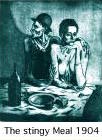 Between 1900 and 1906 he worked through
nearly every major style of contemporary
painting, from impressionism to Art Nouveau.
Between 1900 and 1906 he worked through
nearly every major style of contemporary
painting, from impressionism to Art Nouveau.
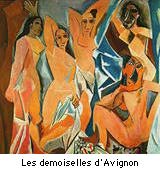 Les Demoiselles d'Avignon - created in 1907 - is generally regarded as the
first cubist painting, and is one of the most revolutionary pictures of his entire career.
Les Demoiselles d'Avignon - created in 1907 - is generally regarded as the
first cubist painting, and is one of the most revolutionary pictures of his entire career.
| People : 1500-2000 | Events: 1907 |